
The history of nuclear power in brief
The history of nuclear power deployment worldwide dates back to the first half of the 20th century, and is marked by scientific, technological and political advances. The development of nuclear power took place in several key stages, from the discovery of radioactivity to the construction of nuclear reactors for electricity generation.
The discovery of radioactivity (1896) and the emergence of nuclear physics (1930-1940)
The history of nuclear power began with the discovery of radioactivity by French scientist Henri Becquerel in 1896. Subsequently, Marie Curie and Pierre Curie furthered their research into radioactive elements, discovering radium and polonium in particular.
In the early 1930s, scientists began to study the atomic nucleus and nuclear reactions. In 1932, James Chadwick discovered the neutron, a particle with no electrical charge present in the atomic nucleus. In 1938, German chemists Otto Hahn and Fritz Strassmann discovered nuclear fission, a process by which a heavy atomic nucleus splits into two lighter ones, releasing a large amount of energy.
Manhattan Project and atomic bomb (1942-1945)
In response to the threat of a German atomic bomb during the Second World War, the United States launched the Manhattan Project, a secret program to build a nuclear weapon. In 1942, Enrico Fermi and his team achieved the first controlled nuclear chain reaction at the University of Chicago. In 1945, the United States developed and used the atomic bomb on the Japanese cities of Hiroshima and Nagasaki, ending the war and ushering in the nuclear age.
After the Second World War, the arms race between the USA and the Soviet Union began, with the construction of ever more powerful nuclear weapons. In 1949, the Soviet Union carried out its first nuclear test, followed by the United Kingdom in 1952, France in 1960 and China in 1964. These five countries became the official nuclear powers recognized by the 1968 Nuclear Non-Proliferation Treaty (NPT).
The advent of civilian nuclear power (1950-1970)
In parallel with the arms race, governments and scientists turned their attention to harnessing nuclear energy for peaceful purposes. In 1951, the EBR-1 experimental reactor in the United States produced the first nuclear-generated electricity. In 1954, the Soviet Union commissioned the world’s first civilian nuclear power plant at Obninsk, near Moscow. In 1956, the United Kingdom inaugurates Calder Hall nuclear power station, the first commercial nuclear power plant.
During the 1960s and 1970s, nuclear power developed rapidly in several countries, including the USA, France, Japan, West Germany and the UK. France, in particular, relied heavily on nuclear power, which became the country’s main source of electricity.
Nuclear accidents and safety debates (1979-1986)
The accident at the Three Mile Island nuclear power plant in the USA in 1979 raised questions about the safety of nuclear installations. This event, followed by the Chernobyl accident in 1986 – the worst nuclear disaster in history – led to a slowdown in the development of nuclear energy and a reassessment of safety standards.
Fukushima disaster (2011)
The accident at Japan’s Fukushima nuclear power plant in 2011, triggered by an earthquake and tsunami, rekindles debate on the safety and viability of nuclear power. Following the accident, several countries, including Germany and Switzerland, decided to gradually reduce their dependence on nuclear power and accelerate the development of renewable energies.
Nuclear deployment worldwide
Today, nuclear power accounts for around 10% of electricity production in 32 countries worldwide. The countries using the most nuclear power are
- United States: 94,718 GW
- France: 61,370 GW
- China: 53,170 GW
- Russia: 27,727 GW
- South Korea: 24,489 GW
- Japan: 16,321 GW
- Canada: 13,624 GW
- Ukraine: 13,107 GW
France is the country with the largest share, accounting for over 70% of electricity production.
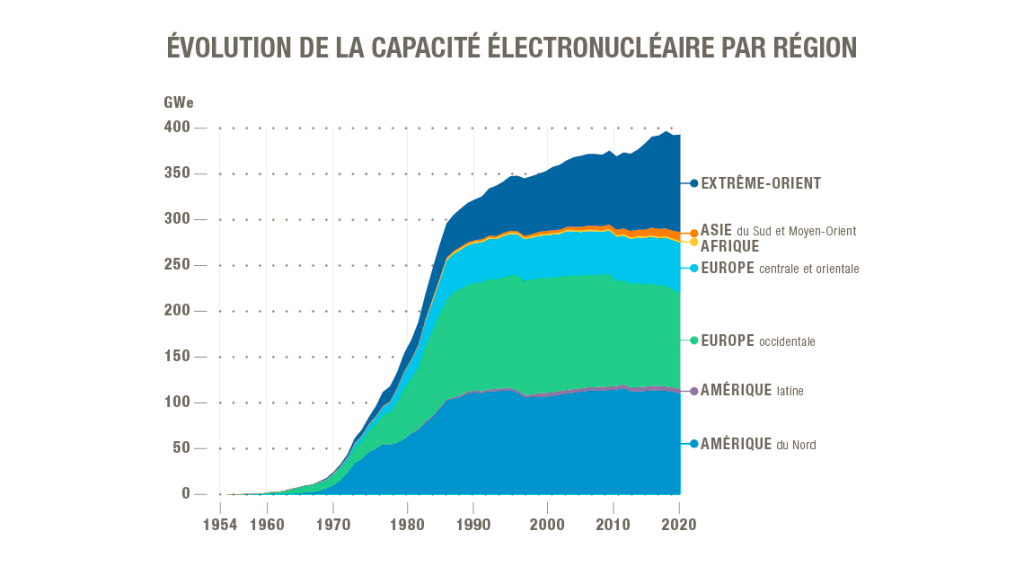
Nevertheless, it is present in many other countries:
- Spain: 7,121 GW
- Sweden: 6,935 GW
- India: 6,795 GW
- United Kingdom: 5,883 GW
- Finland: 4,394 GW
- United Arab Emirates: 4,107 GW
- Germany: 4,055 GW
- Czech Republic: 3,934 GW
- Belgium: 3,928 GW
- Pakistan: 3,262 GW
- Switzerland: 2,973 GW
- Slovakia: 2,308 GW
- Bulgaria: 2,006 GW
- Hungary: 1,916 GW
- Brazil: 1,884 GW
- South Africa: 1,854 GW
- Argentina: 1,641 GW
- Mexico: 1,552 GW
- Romania: 1,300 GW
- Belarus : 1,110 GW
- Iran: 915 GW
- Slovenia: 688 GW
- Netherlands: 482 GW
- Armenia: 448 GW
Data taken from: https://pris.iaea.org/PRIS/WorldStatistics/OperationalReactorsByCountry.aspx (03/2023) and Wikipedia
Nuclear power plant projects
In addition to existing production, there are numerous nuclear power plant projects, a list of which is shown opposite.
Of particular note is the rise of China, which accounts for a third of the production capacity currently being installed. Other notable projects include
- India: India is also planning to increase its nuclear production capacity, with around 7 reactors under construction. Indian projects mainly include domestically-designed Pressurized Heavy Water Reactors (PHWRs), but also Pressurized Water Reactors (PWRs) in collaboration with Russia.
- Russia: Russia is currently building around 5 nuclear reactors to boost its power generation capacity. Projects include pressurized water reactors (PWRs) and fast neutron reactors (FNRs).
- United Arab Emirates: The United Arab Emirates (UAE) is building its first nuclear power plant, the Barakah project, comprising four South Korean-designed pressurized water reactors (PWRs).
- Turkey is working on its first nuclear power plant project, the Akkuyu plant, which will comprise four Russian-designed pressurized water reactors (PWRs).
- France is considering the creation of a new fleet of nuclear power plants to meet the growing demand for electricity.
Romania is also likely to develop new projects in the near future.
More and more 3rd-generation power plant projects, as well as small modular reactors, are now being developed.
| Country | MW | No. of reactors |
|---|---|---|
| Argentina | 25 | 1 |
| Bangladesh | 2 160 | 2 |
| Belarus | 1 110 | 1 |
| Brazil | 1 340 | 1 |
| China | 19 805 | 19 |
| Egypt | 2 388 | 2 |
| France | 1 630 | 1 |
| India | 6 028 | 8 |
| Iran, Islamic Republic of | 974 | 1 |
| Japan | 2 653 | 2 |
| South Korea | 4 020 | 3 |
| Russia | 3 809 | 4 |
| Slovakia | 440 | 1 |
| Turkey | 4 456 | 4 |
| Ukraine | 2 070 | 2 |
| United Arab Emirates | 1 345 | 1 |
| United Kingdom | 3 260 | 2 |
| United States of America | 2 234 | 2 |
| Total | 59747 | 57 |
3rd generation power plants
Speaking of projects, we need to mention the development of 3rd generation power plants, the first of which have come on line in recent years.
The Taishan EPR
- https://www.francetvinfo.fr/monde/chine/chine-une-fuite-dans-un-reacteur-nucleaire-de-l-epr-de-taishan-construit-par-edf_4663739.html
- https://www.marianne.net/monde/asie/fuite-a-la-centrale-nucleaire-de-taishan-un-emballement-parce-que-cest-un-epr-en-chine
Nuclear fuel production facilities
Enriched uranium
Uranium enrichment capacity is essentially (>95%) divided between 4 players: Russia’s Rosatom, France’s Orano, Urenco and China’s CNNC.
For a long time (1952-2013), there was a powerful enrichment plant in Paducah, Kentucky, USA, capable of enriching up to 11 million SWU per year. However, it was shut down in 2013. In the USA, uranium is now enriched at an Urenco facility in Eunice, New Mexico, which produces 4.9 million SWU/year, and imports the rest (total consumption is around 15M SWU/year). There is also a facility at Honeywell Metropolis (MTW), whose production has been put on hold by the low cost of enriched uranium.
A facility is under construction at Piketon, a plant at Rokkasho in Japan is under construction and should reach 1.5M SWU, and the French Georges-Besse 2 plant is undergoing a capacity increase (30%). Orano’s Eagle Rock project in the USA was definitively aborted in 2018.
At an estimated 2,400 kWh per SWU and a global production of 66 million SWU, uranium enrichment would consume 158,400 GWh/year.
| Company | Production sites | Capacity (kt SWU) |
|---|---|---|
| Rosatom | Angarsk Atomic City, Novouralsk, Zelenogorsk, Seversk (Russia) | 27,7 |
| Orano (ex-Areva) | Georges-Besse II plant (France) | 7,5 |
| Urenco | Capenhurst (UK, 8M), Gronau (Germany, 4.5M), Almelo (Netherlands, 6.2M), Eunice (New Mexico, USA, 4.7M) | 13.7 (18.1 in 2023) |
| CNNC | Hanzhun & Lanzhou (China) | 6,3 |
Reprocessed uranium, derived from the mono-recycling of spent fuel, can be enriched in a “conventional” structure. However, it is not mixed with natural uranium, which can pose constraints.
HALEU
TRISO
- The International Atomic Energy Agency (IAEA): https: //www.iaea.org/
- Organisation for Economic Co-operation and Development (OECD): https: //www.oecd.org/fr/nucleaire/
- World Nuclear Association (WNA): https: //www.world-nuclear.org/
- U.S. Energy Information Administration (EIA): https: //www.eia.gov/nuclear/
- OECD Nuclear Energy Agency (NEA) website: https: //www.oecd-nea.org/
- World Nuclear Energy Association (WANO) website: https: //www.wano.org/
- https://www.iaea.org/fr/newscenter/news/en-temps-de-covid-19-le-nucleaire-reste-une-source-denergie-fiable-et-adaptable-en-france-comme-dans-le-reste-du-monde
- https://www.forumnucleaire.be/theme/dans-le-monde